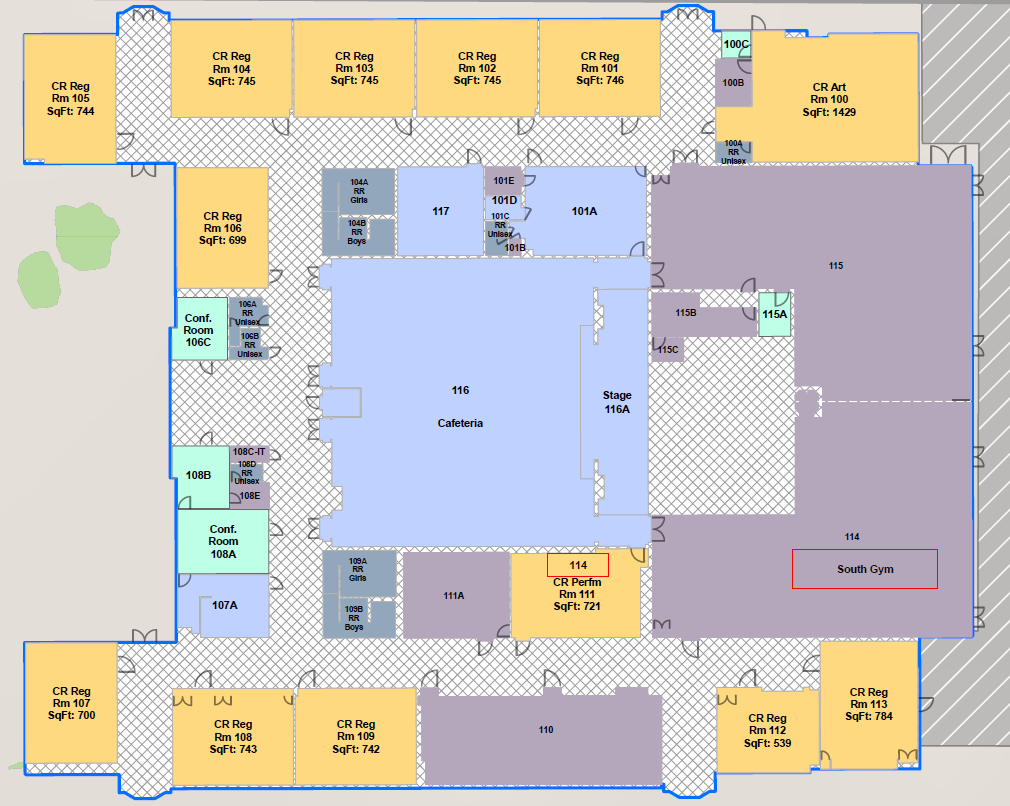
About these ventilation and filtration measurements
Before resuming in-person learning in 2021, PPS had airflow testing conducted in every room of every PPS building. We have corrected gaps in Buckman’s airflow report as originally published by the district, to get this summary. We have also run numbers on one potential plan for Buckman adding Medify units that are being offered to schools by the Oregon Health Authority, if district personnel follow through on signing up to get them by April 28.

Buckman classrooms need more filtration capacity
Even with the Intellipure air purifiers running at their tolerable noise level (half speed):
✘ Classroom with the lowest airflow: 104
2.5 air changes per hour*
With ventilation & filtration this low, how long do kids’ and staff’s viruses in their respiratory aerosols linger in room 104’s air?
>55 minutes
At 2.5 air changes/hour, 55 minutes is how long it takes for the HVAC system and Intellipure to clear out 90% of the respiratory aerosols being produced when kids and staff breathe, talk, sing, cough and sneeze.
✘ 8 more Buckman classrooms have less than 3 air changes per hour
At 3 air changes per hour, it takes the HVAC system and Intellipure 46 minutes to clear 90% of the respiratory aerosols.
✘ 18 more classrooms are between 3 and 6 – all below recommendations
Only 2 classrooms have safe air with ventilation and filtration providing 6 air changes per hour or more, clearing 90% of aerosols out in 23 minutes or less.
Room 111/114: 6.4
Room 112: 7.6 ***
***Good airflow:
Just 18 minutes to clear out 90% of aerosols in Rm 112
These two classrooms have good airflow, but they could be even better. At 12 air changes an hour, aerosols clear out by 90% in under 12 minutes.
The Intellipure air purifiers are insufficient in Buckman classrooms
An Intellipure running at its tolerable noise level only provides 182 cubic feet of clean air per minute. Even at its highest speed setting, which is too noisy, an Intellipure only provides 270 cubic feet of clean air per minute.
Buckman classrooms need additional, high quality air purifiers to provide safe air to kids now, when HVAC system overhauls will take the district years to do in all schools.
PPS staff need to order additional air purifiers for Buckman from the Oregon Health Authority by April 28
We did it! Thank you parents supporting safe indoor air! Thank you PPS and OHA staff and leaders!
The Oregon Health Authority first opened this program at the beginning of April, and at that time, PPS planned to order “no additional units.” But parents like you across our district organized with us to help district staff and leaders understand the need to take full advantage of this opportunity to obtain better air purifiers at no cost to PPS. The district announced initially that they would order only 600 units, but we have over 2600 classrooms in the district.
Parents in our network stepped up again, and our work paid off! PPS announced that they have placed an order for 3500 air purifiers.
We will see for sure how many of which models each school will get when the orders arrive, but we expect this to result in each classroom in the district either having two Medify air purifiers or one Intellipure and one Medify air purifier. And we hope the order will include the MA-1000s for gyms, cafeterias, large libraries, large music rooms and performance rooms, and other large communal spaces that serve students and staff. With both an Intellipure and a Medify, teachers can set the two air purifiers at a quiet speed, but still get more clean air delivered to the room than one Intellipure can deliver, even when it is set at it’s highest setting!
We’re not done working for cleaner classroom air, though. You can still join us below to learn more!
In our analysis that corrects gaps in PPS’s airflow report for Buckman, we have also analyzed one potential plan for adding Medify air purifiers from OHA.
Our analysis looks at what Medify’s would accomplish for ACH values across rooms at Buckman, if added to Buckman according to OHA’s guidelines from the webinar for this program.
See our full analysis and potential plan for Medify’s for Buckman here.
Highlights of our preliminary classification of providing Medify’s to Buckman using OHA’s suggestions for how to distribute them
4 Medify MA-50’s, 30 Medify MA-112’s, and 1 Medify MA-1000’s would:
- Bring all 29 Buckman classrooms to above 3 air changes an hour
- Be especially important to the South Gym, which has zero ventilation and is only getting 0.2 air changes per hour from the Intellipure – adding a Medify MA-1000 would bring the South Gym up to 1.1 air changes an hour
- Have classrooms ranging from 4.2 to 11.2 air changes per hour
When Oregon Health Authority announced their CDC-funded program to provide Oregon schools with free HEPA filters from Medify, our group of parents and community members supporting Safe Indoor Air For Oregon Schools were right in the middle of a push for PPS to budget for adding highly effective, whisper quiet, inexpensive air purifiers to classrooms that do not have the level of airflow we need. Units we were advocating for included CleanAirKits.com Tower of Power (480 cubic feet of clean air per minute at a noise level you can barely hear) and the Owl Air (556 cubic feet of clean air per minute, also at a quiet noise level).
Medify’s do not have quite the high impact clean air delivery rate at such quiet levels as do the Tower of Power and Owl Air filters we demonstrated at the March 21 PPS school board meeting, but Medify’s are decent. Medify MA-112 – which OHA is offering for classrooms – provides 280 cubic feet of clean air per minute at a noise level that won’t distract from teaching in the classroom.
Medify MA-1000’s are being offered for our extra large school spaces. The MA-1000 units can add 1000 cubic feet of clean air per minute to school spaces that can sustain the noise they make at their highest speed setting. At Buckman, that would include the South Gym. If set at their quiet speed setting, the Medify MA-1000’s can also provide 565 cubic feet per minute to other large rooms. OHA is also offering Medify MA-50’s for small spaces like offices, nurse’s office, and conference rooms.
Adding Medify’s on top of the Intellipures would add substantial and much needed filtration capacity to Buckman and other elementary through 8th grade schools. At minimum, we need one additional air purifier for all 597* elementary, middle school, and K-8 classrooms which are below 3 air changes per hour and all 1111* kindergarten through 8th grade classrooms that get between 3 and 6 air changes per hour.
Join us in asking PPS and OHA to add these new filters while also maintaining the existing filtration capacity the Intellipures provide.
How can you help?
We need to make sure PPS and OHA provide more air purifiers to Buckman – Sign up to help advocate for PPS ordering these units and OHA granting them!
Let’s get more air filtration in the 9 Buckman classrooms that do not even get 3 changes of air per hour and the 18 classrooms that only get between 3 and 6! And let’s make sure Buckman’s cafeteria, where kids pack in close to eat lunch, and library and other key spaces get better air quality.
Join us to be part of a group of parents and community members advocating for strategic, effective, and science-based planning for sufficient ventilation and filtration capacity in PPS schools – including Buckman.
Sign up on our signup form to also help make a better proposed plan for Buckman. Facilities staff worked hard to get the Intellipures, but PPS left serious gaps in the ventilation and filtration in elementary, middle school, and K-8 schools across the district.
So we would like participation and feedback from more PPS community members – parents, family, and actual staff in our schools – on what spaces in each school are actually used for what, so that PPS kids and staff, including kids and staff at Buckman, get more of the quiet, effective filtration capacity that they need. Sign up below to join our organizing for PPS air quality!
*Notes on our numbers
Air changes per hour given here are “equivalent” and include ventilation and filtration. These numbers are based on the district’s airflow report for Buckman, conducted in August 2021 (available at tinyurl.com/buckmanairflow) but corrected using specifications from the manufacturer of the Intellipure units to allow calculation of air changes per hour with the Intellipure at half speed instead of the district-provided air changes per hour with the Intellipure set at full speed.
Also, please note that the total classrooms across the district below 3 and between 3 and 6 are 597 / 1111 and counting…